Commercial Lease Renewal vs. Relocation in Dallas: When Should Your Business Move?
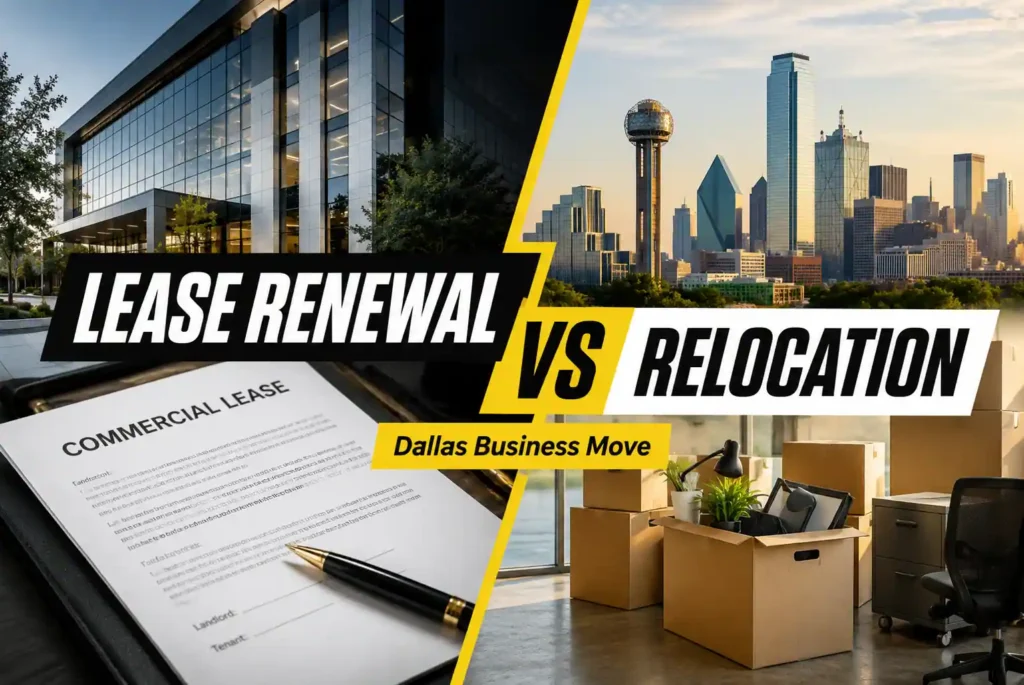
When a commercial lease expiration in Dallas approaches, many businesses assume they have two simple choices: renew the existing lease or find a new property.
In reality, the decision is more strategic.
A commercial lease renewal may minimize disruption, but staying can become expensive if the property no longer supports your workforce, customers, operations, or growth. A commercial relocation in Dallas may create opportunities for better lease terms, a stronger location, or a more efficient space but moving also brings costs and operational risks.
The best decision comes from comparing both options before committing to either one.
For Dallas-Fort Worth office tenants, timing is especially important in the current market. DFW office vacancy stood at 23.9% in Q2 2026, while average asking rents reached $34.17 per square foot. Class A asking rents reached a record $40.08 per square foot, and top-tier properties continued to tighten even as landlords across much of the market offered meaningful concessions.
That creates opportunities but not equally in every building or submarket.
Should You Renew Your Commercial Lease or Relocate?
Renew your commercial lease when your location still supports your business, the space fits future needs, and the landlord offers competitive economic terms. Consider relocating when the property limits growth, costs have become unfavorable, employees or customers struggle with the location, or better alternatives provide meaningful operational and financial advantages.
The right answer should be based on total business impact rather than rent alone.
Commercial Lease Renewal vs. Relocation: Quick Comparison
| Factor | Lease Renewal | Relocation |
| Business Disruption | Usually lower | Usually higher |
| Moving Expenses | Minimal | Can be significant |
| Negotiation Leverage | Stronger with alternatives | Competition among landlords may help |
| Space Efficiency | Limited by current property | Opportunity to redesign |
| Employee Impact | Familiar commute | Commutes may improve or worsen |
| Brand Positioning | Usually unchanged | Opportunity to upgrade |
| Growth Potential | Depends on existing building | Greater location flexibility |
| Upfront Costs | Often lower | Moving, furniture and construction costs |
| Operational Flexibility | Limited to current options | Opportunity to rethink real estate strategy |
Neither option is automatically better. A renewal can be a strong business decision, while an unnecessary move can waste capital. At the same time, automatically renewing because moving seems difficult can lock a company into an unsuitable property for years.
When Does Renewing a Commercial Lease Make Sense?
A Dallas commercial lease renewal may be the best option when the fundamentals of the existing location still work.
Your Space Still Fits the Business
If your current property provides the right amount of space, layout, parking, loading capabilities, visibility, and infrastructure, moving simply for the sake of change may offer little value.
The key question is whether the property will still work two, five, or even ten years into the future not whether it works today.
Your Location Still Supports Employees and Customers
Location should be measured against the people who actually use the property.
For an office tenant, that may mean employee commuting patterns and access to talent. A retailer may prioritize traffic, visibility, demographics, and customer access. An industrial company may focus on highways, labor, loading, and distribution efficiency.
LINC Commercial Realty’s commercial tenant representation services incorporate location analysis and business objectives when evaluating potential properties throughout DFW.
The Renewal Economics Are Competitive
A landlord may offer attractive terms to retain a reliable tenant, especially when losing that tenant would create vacancy, improvement costs, leasing commissions, and marketing expenses.
However, businesses should never assume a renewal proposal is competitive simply because it is lower than the asking rent at another building.
Compare:
- Base rent
- Operating expenses or CAM charges
- Annual rent increases
- Tenant improvement allowances
- Free rent
- Parking costs
- Renewal options
- Expansion rights
- Maintenance responsibilities
- Other occupancy expenses
LINC advises tenants using current market information and comparable lease data when evaluating alternatives and negotiating commercial leases.
When Should Your Business Consider Relocating?
A commercial relocation in Dallas should solve a meaningful business problem or create a significant opportunity.
1. Your Current Space No Longer Fits
You may have too much space after adopting a hybrid work model or too little space because the company has grown.
An inefficient footprint can quietly increase occupancy costs.
For example, paying a lower rent for 30,000 square feet may be less economical than paying a higher rate for a well-designed 20,000-square-foot space that better matches actual operations.
2. The Location Is Hurting Recruitment or Retention
Employee access is becoming a bigger factor in many Dallas office relocation decisions.
If a company’s workforce has shifted geographically, an office that once made sense may now create unnecessarily difficult commutes.
For customer-facing businesses, the issue may instead be population growth, traffic patterns, visibility, nearby competitors, or changing demographics.
3. Your Building Cannot Support Your Operations
Relocation may become necessary when the property lacks:
- Sufficient parking
- Reliable building systems
- Adequate power
- Modern technology infrastructure
- Loading capabilities
- Expansion space
- Appropriate zoning
- Customer visibility
- Required accessibility
Trying to force an outdated property to support changing business requirements can ultimately cost more than moving.
4. Better Properties Offer Greater Long-Term Value
The Dallas market is not uniform.
For office users, overall vacancy remained elevated in Q2 2026, but stronger demand for top-tier Class A space was tightening availability in many high-quality properties. At the same time, landlords were still using free rent and tenant improvement allowances to compete for tenants in parts of the market.
This means businesses should compare buildings individually instead of relying on broad statements such as “Dallas is a tenant’s market.”
The Hidden Costs of Staying vs. Moving
One of the most common mistakes in a commercial lease renewal vs. relocation analysis is comparing only rental rates.
Costs of Staying
A renewal can involve:
- Higher rent
- Increased operating expenses
- Renovation costs
- Furniture replacement
- Technology upgrades
- Temporary construction disruption
- Lost opportunity to improve space efficiency
Costs of Moving
Relocation can involve:
- Physical moving expenses
- New furniture
- Construction and build-out costs
- Technology installation
- Signage
- Professional fees
- Employee disruption
- Potential business downtime
- Lease overlap between locations
The correct comparison is therefore not:
Current rent vs. new rent.
It is:
Total cost of staying vs. total cost of relocating over the complete lease term.
How Far in Advance Should You Evaluate Your Lease?
Businesses should begin evaluating options well before the existing lease expires.
A smaller, straightforward lease may require less preparation, while a headquarters, medical facility, industrial property, restaurant, or heavily customized space may require considerably more time.
A practical planning process should include:
- Reviewing the existing lease.
- Defining future space requirements.
- Establishing an occupancy budget.
- Researching available alternatives.
- Comparing renewal and relocation economics.
- Negotiating competing options.
- Completing legal and operational due diligence.
- Planning construction and relocation if necessary.
Waiting too long can weaken your leverage because the landlord may realize you no longer have enough time to move comfortably.
A Simple Renewal-or-Relocation Decision Framework
Consider Renewing When:
- The location still works.
- The property supports future operations.
- The space can accommodate anticipated growth.
- The landlord maintains the building well.
- Renewal economics are competitive.
- Moving would create more cost than value.
Consider Relocating When:
- The company has outgrown the space.
- You are paying for significant unused space.
- Employee or customer access has become a problem.
- The building limits operations.
- Another location offers strategic advantages.
- The current landlord will not offer competitive terms.
Explore Both Options When:
- You are uncertain.
In many cases, this is the smartest approach.
Creating credible relocation alternatives can help a business understand its true options and may also strengthen its position during renewal negotiations.
Common Commercial Lease Renewal Mistakes
Waiting Until the Last Minute
Limited time reduces flexibility and can weaken negotiating leverage.
Negotiating Only With the Existing Landlord
Without understanding competing properties, businesses may have no reliable way to determine whether a renewal offer reflects the market.
Focusing Only on Rent
Lease structure, operating expenses, concessions, construction obligations, flexibility, and occupancy costs can materially change the economics.
Ignoring Future Business Plans
A property that works for today’s business may become restrictive before the next lease expires.
Treating the Renewal as a Routine Transaction
A lease renewal is an opportunity to reconsider location, space utilization, lease flexibility, and long-term real estate strategy.
LINC Commercial Realty’s commercial real estate advisory services include market analysis, lease review, comparable lease analysis, and evaluation of property alternatives for businesses throughout Dallas-Fort Worth.
Key Takeaways
The decision between a commercial lease renewal and relocation in Dallas should begin with your business strategy not with a landlord’s renewal proposal.
Renewing may be the right move when the current space remains functional and the economics are competitive.
Relocating may be better when a new property can improve efficiency, recruitment, customer access, growth capacity, or long-term costs.
The strongest approach is often to evaluate both.
LINC Commercial Realty works with Dallas-Fort Worth businesses on lease negotiations, renewals, expansions, relocations, and property searches. Its tenant representation services are designed to align real estate decisions with operational needs, budgets, growth objectives, and location requirements.
Businesses approaching a lease expiration can contact LINC Commercial Realty to evaluate whether renewing or relocating provides the stronger long-term business outcome.
Frequently Asked Questions
Yes. Renewal terms may be negotiable, including rent, annual increases, tenant improvements, renewal options, and other provisions. Your leverage depends on the property, market conditions, alternatives, and timing.
A commercial tenant representative in Dallas can help compare the landlord’s renewal proposal against alternative properties and current market conditions. LINC provides tenant representation for renewals, new leases, expansions, and other leasing requirements.
No. Moving has upfront costs, but a more efficient space or stronger lease package can sometimes create better long-term economics.
Possibly. Options depend on available suites, landlord flexibility, lease terms, and whether the existing premises can be reconfigured.
You may have fewer realistic relocation alternatives, which can reduce negotiating leverage and create pressure to accept less favorable terms.
A tenant improvement allowance can offset qualifying build-out expenses. In the DFW office market, concession packages vary significantly by building quality, location, occupancy, and lease term.
Yes. Commute accessibility can affect recruitment, retention, attendance, and employee satisfaction, making workforce geography an important location consideration.
Yes. A company may lower its total occupancy cost by moving into a more efficient footprint, even when the new property’s quoted rent is higher.
No. DFW office vacancy was 23.9% in Q2 2026, but top-tier buildings were outperforming the broader market, meaning negotiating conditions can differ significantly by property and submarket.
Review the existing lease, amendments, operating expense statements, renewal provisions, notices, insurance requirements, and relevant financial obligations with appropriate professional advisors.
A landlord can propose new rental terms unless an existing renewal option establishes specific pricing rules. The outcome depends on the lease and negotiations.
The most important factor is whether the real estate supports your long-term business objectives at an acceptable total cost.