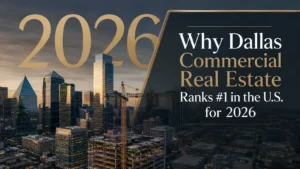
Why Dallas Commercial Real Estate Ranks #1 in the U.S. for 2026
Dallas has become one of the most closely watched commercial real estate markets in the country. For investors, business owners, developers, and tenants, the question is no longer whether Dallas-Fort Worth is growing. The better question is how to make smart commercial real estate decisions in a market that continues to attract national attention.
For 2026, Dallas-Fort Worth earned the No. 1 spot in the Urban Land Institute and PwC “Emerging Trends in Real Estate” Markets to Watch ranking, staying at the top for the second year in a row. The ranking reflects investment and development prospects across real estate sectors, not just one property type.
That matters because Dallas commercial real estate is being shaped by more than short-term demand. Population growth, corporate expansion, logistics strength, data center activity, office repositioning, and suburban development are all working together. For a local firm like LINC Commercial Realty, this creates real opportunities, but also a need for careful strategy.
Why Is Dallas Commercial Real Estate Ranked So Highly in 2026?
Dallas-Fort Worth ranks highly because it combines several factors that many other U.S. markets struggle to balance: business growth, job creation, affordability compared with coastal metros, transportation access, and a diverse commercial property base.
ULI and PwC named Dallas-Fort Worth the top market to watch in 2026 based on survey input from real estate professionals rating investment and development prospects. That distinction supports what local brokers, investors, and businesses already see on the ground: Dallas is not dependent on one industry or one neighborhood.
Office, industrial, retail, multifamily, medical, mixed-use, and data center demand all play a role. The result is a commercial real estate market with multiple paths for growth instead of relying on one trend.
What Is Driving Commercial Real Estate Growth in Dallas?
Population and Job Growth Support Long-Term Demand
Commercial real estate follows people, jobs, and business activity. As more residents and companies move into North Texas, demand increases for offices, warehouses, restaurants, retail centers, medical space, service businesses, and neighborhood commercial properties.
The Texas Real Estate Research Center reported continued office-using job growth in DFW, noting that the market added 167,200 office jobs over a five-year period through August 2025. That kind of employment base supports demand for professional services, corporate offices, flex space, and supporting retail.
This is one reason Dallas commercial real estate remains attractive even when national headlines about office space sound cautious. Not every office market is moving the same way. In Dallas, quality, location, tenant mix, and building class matter more than broad assumptions.
Corporate Relocations and Business Expansion Keep Dallas Competitive
Dallas continues to benefit from its reputation as a business-friendly market. Companies are drawn to North Texas because of its central location, strong labor pool, transportation infrastructure, and access to both regional and national customers.
CBRE’s Dallas-Fort Worth 2026 market outlook points to strong tenant demand, suburban spillover, investor interest in industrial, and continued opportunities in retail and mixed-use development.
For commercial property investors, this means demand is not limited to downtown Dallas. Submarkets across North Dallas, Plano, Frisco, McKinney, Irving, Richardson, Addison, and other parts of the Metroplex continue to matter.
Which Commercial Real Estate Sectors Are Strongest in Dallas?
Industrial and Logistics Real Estate
Industrial real estate remains one of Dallas-Fort Worth’s strongest commercial property sectors. The Metroplex has a central U.S. location, major highway access, rail connections, DFW International Airport, and a large consumer base. That makes it attractive for distribution, warehousing, manufacturing, and logistics users.
CBRE’s 2026 outlook notes that Dallas-Fort Worth’s competitive advantages continue to attract industrial investors, with manufacturing, logistics, and data center demand supporting the market.
For investors, industrial properties can offer long-term stability, but site selection is critical. Access, clear height, truck circulation, zoning, tenant credit, and lease structure all affect value.
Office Space and Tenant Demand
Dallas office real estate is more nuanced than the national office story. Some older or poorly located buildings may face pressure, while Class A, well-located, amenity-rich office properties can remain competitive.
CBRE expects strong tenant demand to create suburban spillover and limit availability in prime and Class A buildings. For tenants, this means the best spaces may require earlier planning and stronger lease negotiation. For landlords, it means building quality, improvements, and positioning are more important than ever.
This is where tenant representation and landlord representation become valuable. A local commercial broker can compare submarkets, evaluate concessions, negotiate terms, and help clients avoid costly lease mistakes.
Retail and Mixed-Use Development
Retail in Dallas is being reshaped by population growth, suburban expansion, and mixed-use development. Retail demand follows rooftops, traffic counts, income levels, and daily convenience needs.
CBRE’s outlook notes that mixed-use development will become more common in new projects and redevelopments, while transportation investment may create new retail opportunities.
That is important for restaurants, service brands, medical users, fitness concepts, and franchise operators looking for visibility and customer access.
Data Centers and Technology-Driven Demand
Data centers have become a major part of the Dallas-Fort Worth commercial real estate conversation. CBRE reported that DFW became the nation’s third-largest colocation data center market, with inventory rising 43.7% year over year in Q1 2026 and a record-high 716.7 MW under construction.
This matters beyond data centers themselves. AI, cloud computing, and digital infrastructure can influence land demand, power availability, industrial development, construction activity, and investor interest across North Texas.
Is Dallas a Good Market for Commercial Real Estate Investors in 2026?
Yes, Dallas is a strong market for commercial real estate investors in 2026, but success depends on asset selection, pricing, financing, and submarket knowledge.
A top-ranked market does not mean every property is a good investment. Some assets may be overpriced. Some leases may carry hidden risks. Some locations may look strong today but have future access, vacancy, or tenant-demand concerns.
Investors should evaluate:
- Property type and tenant demand
- Lease terms and rollover risk
- Operating expenses and property taxes
- Submarket vacancy and absorption
- Future development pipeline
- Access, visibility, and infrastructure
- Exit strategy and long-term value
LINC Commercial Realty supports clients with commercial real estate services such as tenant representation, acquisitions and dispositions, advisory services, and property management in the Dallas area. That local perspective can help investors move beyond headlines and focus on deal-level fundamentals.
What Should Business Owners Know Before Leasing Commercial Space in Dallas?
Business owners should understand that leasing commercial space is not just about rent. The total cost of occupancy may include base rent, NNN expenses, utilities, maintenance responsibilities, tenant improvements, signage rights, parking, renewal options, and relocation costs.
In a competitive Dallas commercial real estate market, tenants should ask:
- Does this location match my customer base?
- Will the lease allow my business to grow?
- Who pays for repairs and improvements?
- Are there renewal options?
- What happens if I need to expand or exit early?
- Is the rent aligned with the submarket?
Strong tenant representation can help business owners compare options, negotiate better terms, and avoid signing a lease that limits growth.
Dallas commercial real estate ranks #1 for 2026 because Dallas-Fort Worth offers strong investment and development prospects, population and job growth, corporate expansion, industrial demand, retail activity, and rising data center investment. Its diverse economy and active submarkets make it one of the most resilient commercial property markets in the U.S.
Conclusion
Dallas commercial real estate is leading the national conversation in 2026 for good reason. The market has strong fundamentals, broad demand drivers, and multiple asset classes creating opportunity across the Metroplex.
Still, a high-ranking market does not remove risk. Smart decisions require local insight, careful analysis, and the right commercial real estate strategy. For investors, tenants, landlords, and business owners evaluating opportunities in Dallas, LINC Commercial Realty can help turn market momentum into informed action.
FAQs
Dallas-Fort Worth ranked No. 1 in ULI and PwC’s 2026 Markets to Watch list because real estate professionals rated it highly for investment and development prospects. The market benefits from business growth, population expansion, industrial strength, and a diverse economy.
Dallas can be a strong place to buy commercial property, especially for investors focused on long-term demand. However, buyers should review tenant quality, lease terms, financing, location, property condition, and submarket trends before making a decision.
Industrial, logistics, Class A office, retail, mixed-use, and data center-related properties are among the most active sectors. The best choice depends on the investor’s goals, risk tolerance, budget, and preferred hold period.
Population growth increases demand for retail, medical space, restaurants, offices, warehouses, and service-based businesses. As more people move into North Texas, commercial properties in well-positioned submarkets can benefit from stronger tenant demand.
Leasing may be better for flexibility, lower upfront cost, and growing businesses. Buying may make sense for established companies that want long-term control and equity. A commercial real estate advisor can help compare both options.
A local broker understands submarket pricing, lease structures, tenant demand, property values, and negotiation norms. In a competitive market like Dallas, that knowledge can help investors and tenants avoid costly mistakes.