Small-Bay Industrial Real Estate in DFW: What Investors Need to Know
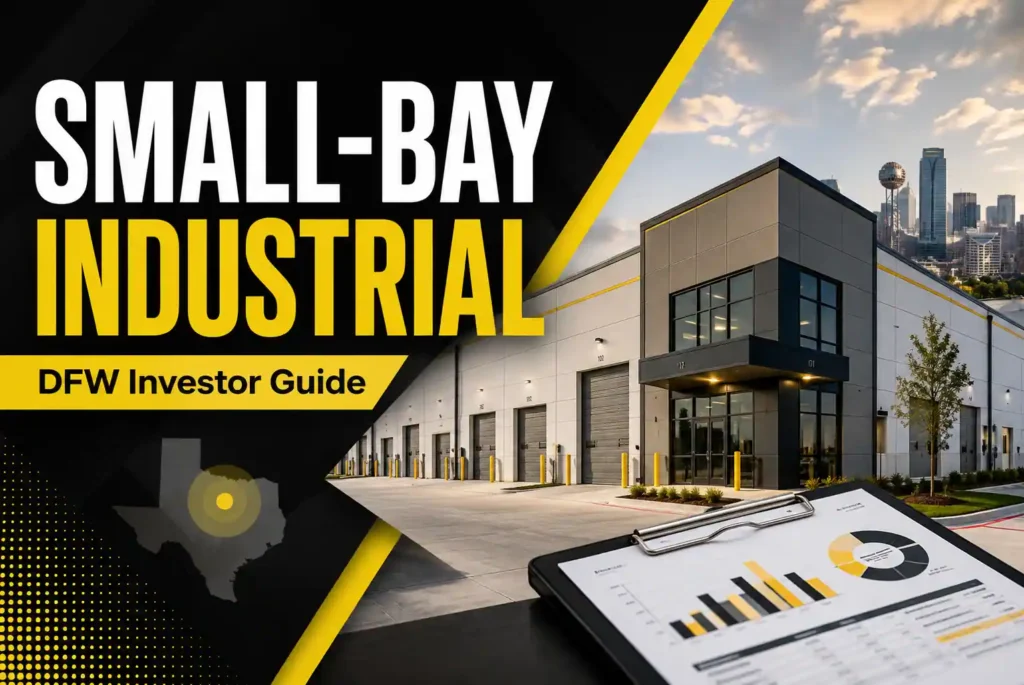
Small-bay industrial real estate in DFW has attracted growing investor attention for a simple reason: it serves the everyday businesses that keep a major metropolitan economy moving.
Contractors, local distributors, service companies, manufacturers, e-commerce businesses, building suppliers, automotive-related operators, and other small and midsize companies often need functional industrial space close to their customers and employees. Unlike large distribution centers, these businesses typically cannot solve their real estate needs with a remote megawarehouse.
For investors, however, small-bay industrial properties are not automatically safe or simple investments. Success depends on location, tenant demand, building functionality, lease structure, capital requirements, management, and most importantly the price paid.
Here is what investors should understand before acquiring Dallas-Fort Worth industrial real estate.
What Is Small-Bay Industrial Real Estate?
Small-bay industrial real estate generally refers to industrial properties divided into smaller tenant spaces rather than one large warehouse occupied by a single company. There is no universal size definition, but these properties often accommodate local and regional businesses requiring warehouse, showroom, light manufacturing, service, storage, or flex space.
Typical features may include:
- Multiple tenant suites
- Grade-level or dock-high loading
- Office and warehouse combinations
- Smaller individual footprints
- Parking for employees and service vehicles
- Convenient access to population centers
- Flexible configurations for different business types
Small-bay properties should not automatically be confused with flex industrial space. Flex buildings often contain a higher percentage of office or showroom space, while traditional small-bay buildings may be more warehouse-oriented.
Why Are Investors Interested in Small-Bay Industrial Properties?
The investment thesis usually comes down to diversification, replacement difficulty, location, and a broad tenant base.
1. Demand Comes From Many Types of Businesses
A large distribution center may depend on attracting a relatively narrow group of major occupiers. A well-located multi-tenant industrial property, by comparison, may appeal to plumbers, electricians, contractors, wholesalers, manufacturers, suppliers, repair businesses, and countless other operators.
This can diversify tenant demand.
The broader DFW industrial market also remains active. Cushman & Wakefield reported 20.5 million square feet of leasing during Q2 2026, bringing first-half activity to a record 40.3 million square feet. Demand was spread across third-party logistics, manufacturing, e-commerce, and businesses serving the data center sector. Overall industrial vacancy declined to 8.1%.
Those marketwide figures include properties much larger than typical small-bay assets, so investors should not use them as a substitute for property-level submarket analysis.
2. Infill Locations Can Be Difficult to Replicate
Many established DFW small-bay industrial properties occupy locations where available land has become limited or more expensive.
An older but functional industrial park near customers, highways, skilled labor, and dense residential areas may therefore possess advantages that a newer building farther from the urban core cannot easily reproduce.
For investors, this creates an important principle:
Building age matters, but location and functionality often matter more.
An older property with strong access, suitable loading, sufficient parking, usable clear heights, and durable tenant demand may outperform a newer asset in a weak location.
3. Multiple Tenants Can Reduce Single-Tenant Exposure
A 100,000-square-foot property occupied by 15 businesses has a different risk profile from a 100,000-square-foot building occupied by one tenant.
When one small-bay tenant leaves, only part of the property’s income disappears. However, diversification comes with a tradeoff: more tenants mean more leases, renewals, maintenance requests, collections, and turnover to manage.
That makes experienced DFW commercial property management particularly important for multi-tenant assets.
What Does the Current DFW Industrial Market Mean for Investors?
The latest market data points to improving overall industrial fundamentals, but investors need to look beneath the headline numbers.
As of Q2 2026, DFW industrial vacancy was 8.1%, asking rents had reached a marketwide high of $9.19 per square foot on a net basis, and leasing activity remained exceptionally strong. Cushman & Wakefield also reported that warehouse/distribution vacancy had fallen to 9.1%.
Yet performance varies significantly by property type and building size.
Partners reported that flex properties had a 7.0% vacancy rate in Q1 2026 but also recorded negative quarterly net absorption, while the wider market’s positive absorption was largely driven by warehouse and distribution properties.
Investor takeaway: Never purchase a small-bay property based solely on a headline such as “DFW industrial is strong.”
Analyze the specific:
- Submarket
- Building size
- Suite size
- Tenant industry
- Competing inventory
- Asking and achieved rents
- Lease rollover schedule
- Property condition
Small-Bay vs. Big-Box Industrial: Investor Comparison
| Factor | Small-Bay Industrial | Big-Box Industrial |
| Typical Tenant Base | Local and regional businesses | Major logistics and corporate occupiers |
| Tenant Diversification | Often higher | Often lower |
| Management Intensity | Higher | Lower with fewer tenants |
| Lease Administration | More complex | Usually simpler |
| Vacancy Exposure | Spread across multiple suites | Large when a major tenant leaves |
| Location Priority | Often close to customers | Often highway and logistics driven |
| Capital Needs | Frequent smaller improvements | Potentially large tenant-specific costs |
| Leasing Strategy | Continuous | Less frequent but higher-stakes |
Neither asset class is inherently better. The right investment depends on the investor’s return objectives, management capabilities, capital structure, and risk tolerance.
7 Things Investors Should Analyze Before Buying
1. Tenant Rollover
Review how much rent expires each year.
A property advertised as “100% occupied” may still carry significant risk if half the tenants can leave within 12 months.
2. In-Place Rents vs. Market Rents
Below-market rents can create upside but only when leases actually roll and tenants can absorb increases.
Do not assume every below-market lease can immediately be reset.
3. Suite Functionality
Ask whether future tenants will want the existing spaces.
Review:
- Loading
- Clear height
- Power capacity
- Parking
- Truck access
- Office percentage
- HVAC
- Fire protection
- Outdoor storage rights
Functional obsolescence can limit demand even in a strong market.
4. Tenant Quality and Industry Exposure
A diversified rent roll is valuable only when the tenants themselves are viable.
Review business types, payment history, security deposits, lease guarantees, concentration risk, and dependence on individual industries.
5. Deferred Maintenance
Older industrial assets may hide expensive problems.
Carefully inspect roofs, pavement, drainage, HVAC equipment, electrical systems, foundations, loading areas, and life-safety systems.
6. Zoning and Surrounding Development
Industrial zoning can be a competitive advantage.
Investors should verify current zoning, permitted uses, outdoor storage restrictions, environmental considerations, and whether nearby redevelopment could eventually affect industrial operations.
7. Realistic Operating Expenses
Multi-tenant properties require active management.
Build realistic assumptions for repairs, vacancies, leasing commissions, tenant improvements, legal expenses, property management, insurance, taxes, and capital reserves.
Common Small-Bay Industrial Investment Mistakes
One of the biggest mistakes is buying based on projected rent growth instead of existing property fundamentals.
Investors should avoid:
- Using marketwide DFW data without analyzing the local submarket.
- Assuming all industrial buildings perform the same way.
- Overestimating immediate mark-to-market rent opportunities.
- Underestimating tenant improvements and leasing costs.
- Ignoring short-term lease rollover concentration.
- Failing to inspect aging building systems.
- Treating property management as an afterthought.
A strong acquisition should make financial sense under realistic assumptions not only under the most optimistic scenario.
Is Small-Bay Industrial Real Estate in DFW a Good Investment?
Small-bay industrial real estate in DFW can be attractive for investors seeking diversified tenant income, infill locations, and exposure to businesses that require physical operating space. However, returns depend heavily on acquisition basis, location, building functionality, lease structure, capital expenses, and active management.
Current DFW industrial fundamentals provide a constructive backdrop, with strong leasing activity and declining overall vacancy reported in Q2 2026. At the same time, performance differs across building sizes and property types, making asset-specific underwriting essential.
Investors evaluating an acquisition should stress-test the property under multiple scenarios rather than relying on a single growth forecast.
Small-Bay Industrial Due Diligence Checklist
Before acquiring a property, review:
- Current rent roll
- Historical occupancy
- Lease expirations
- Tenant credit and payment history
- Comparable asking and achieved rents
- Roof and HVAC condition
- Parking and loading functionality
- Environmental reports
- Zoning and permitted uses
- Insurance costs
- Property taxes
- Deferred maintenance
- Capital improvement needs
- Competing available properties
- Future development pipeline
For investors evaluating opportunities in North Texas, LINC Commercial Realty provides commercial real estate acquisition and disposition services, advisory support, and local market guidance. LINC also provides hands-on property management for DFW commercial assets and specifically works with local and out-of-state investors.
Key Takeaways
Small-bay industrial real estate can offer compelling opportunities, but investors should look beyond the popularity of the industrial sector.
The strongest opportunities generally combine:
• A durable infill location
• Functional industrial space
• Diverse tenant demand
• Sustainable rents
• Manageable lease rollover
• Limited deferred maintenance
• A disciplined acquisition price
• Professional asset and property managementThe most important question is not simply, “Should I invest in DFW industrial?”
It is:
Does this specific property offer the right combination of income, risk, location, functionality, and long-term value at today’s price?
For investors considering a purchase, sale, or portfolio strategy, LINC Commercial Realty’s real estate advisory services can help evaluate opportunities within the broader Dallas-Fort Worth commercial property market.
Frequently Asked Questions
Common tenants include contractors, distributors, service businesses, wholesalers, light manufacturers, e-commerce companies, repair businesses, suppliers, and other companies requiring a combination of storage and operational space.
Multiple tenants can diversify rental income and reduce dependence on one occupant. The tradeoff is greater management and leasing complexity.
They can be. Investors should prioritize location, building functionality, tenant demand, property condition, and acquisition price rather than judging an asset solely by age.
There is no single risk, but lease rollover, deferred maintenance, tenant credit, poor functionality, and overpaying are among the most important issues to evaluate.
Very important for many tenants. Service businesses may need employee parking, customer spaces, work vehicles, trailers, or fleet storage, depending on permitted uses.
Not automatically. Occupancy should be evaluated alongside rent levels, lease expiration dates, tenant quality, property condition, and future leasing costs.
Yes, but the opportunity depends on lease expirations, actual comparable rents, tenant retention, improvement costs, and the market’s ability to support higher pricing.
Key areas include the roof, pavement, HVAC systems, electrical capacity, foundations, drainage, loading areas, fire protection systems, and potential environmental concerns.
Effective management can support tenant retention, expense control, maintenance planning, lease administration, and faster responses to operational issues.
Ideally, before selecting a property. Early analysis can help investors compare opportunities, evaluate pricing, identify risks, and build more realistic acquisition assumptions.